 We encourage you to play responsibly. For guidelines
How to Play Chemin de Fer Card Game
By Daniel Grant
Updated 11 Jul, 2025

Complete Guide to Chemin de Fer
Chemin de Fer is a variant of the popular casino card game Baccarat and is best known as James Bond’s game of choice in films such as On Her Majesty’s Secret Service. The game follows similar rules to those of Baccarat, but with a few interesting differences. Let’s take a closer look at this intriguing card game.
What is Chemin de Fer?
Chemin de Fer, or Chemmy for short, is one of three popular variants of Baccarat (in addition to Punto Banco and Baccarat Banque) that can be found in casinos across Europe, particularly France, where it is the most popular variant, and Latin America. Like Baccarat, the game involves two betting positions, Player and Banker, where the goal for each is to get a hand value closest to 9 without going over. However, it’s the twists away from Baccarat that make this casino card game so engaging, as we’ll soon see. First though, a bit about Chemmy’s origins.
Chemin de Fer’s origin story
Like many classic card games, Chemin de Fer originated in France, first appearing in the country in the 19th century. It emerged as a variant of Baccarat that was played with tarot cards at the time. Chemin de Fer was initially reserved for nobility before appearing in the country’s casinos and becoming more widespread.
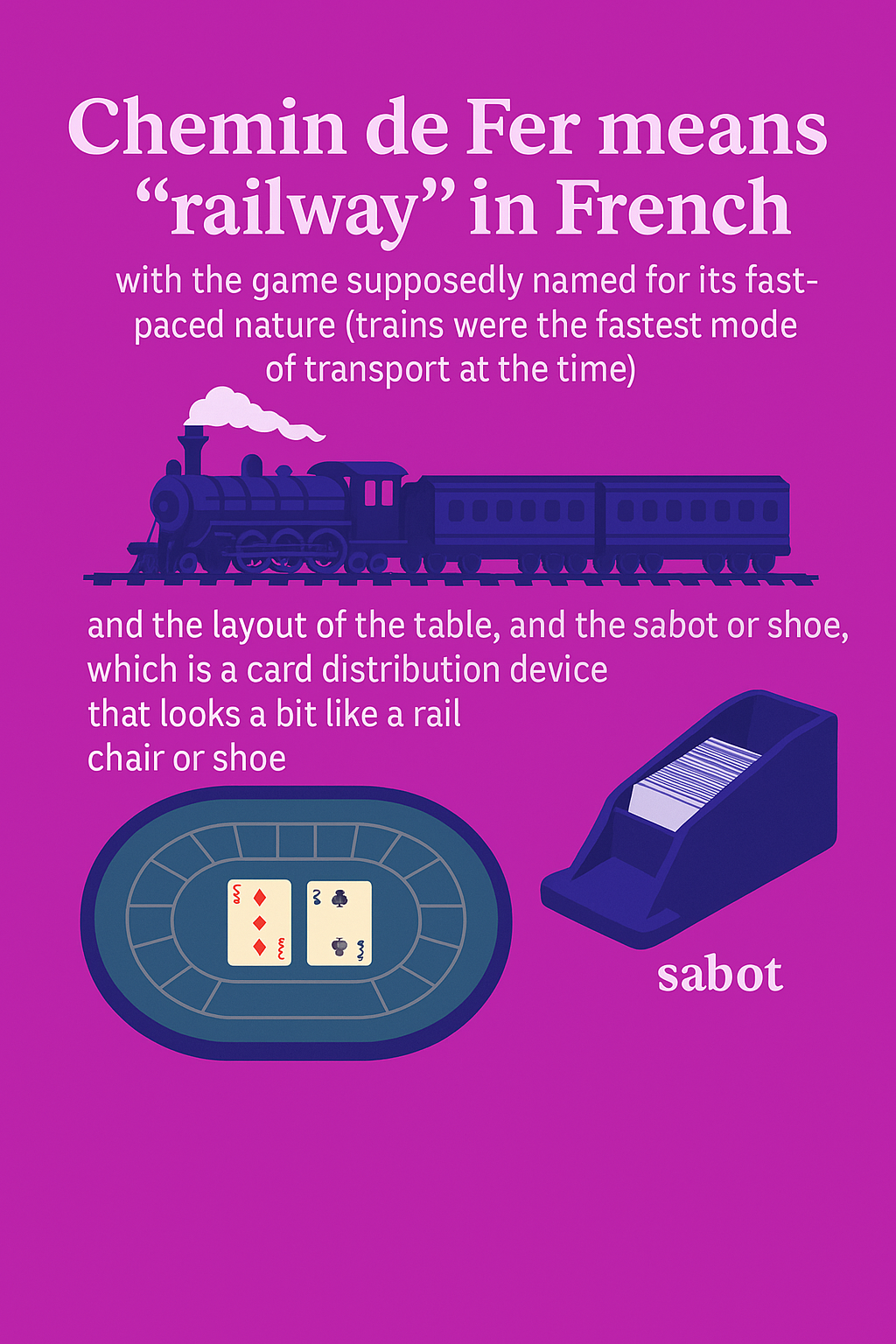
Chemin de Fer means ‘railway’ in French, with the game supposedly named for its fast-paced nature (trains were the fastest mode of transport at the time), the layout of the table, and the sabot or shoe, which is a card distribution device that looks a bit like a rail chair or shoe.
Chemin de Fer v Baccarat
The first difference between these two card games is in their origin, with Baccarat dating back as far as the 15th century, while Chemin de Fer, as Baccarat’s variant, didn’t appear until the latter part of the 19th century.
However, it’s in the gameplay that Baccarat and Chemin de Fer really differ. The biggest difference between these casino games is that while players in Baccarat compete only against the house, in Chemin de Fer, players compete against each other. This is why Chemin de Fer is referred to as a player-banked game.
Another major difference is that Baccarat players can decide to bet on either the Banker or Player positions (or the Tie), whereas players in Chemin de Fer can only bet on Player (unless they’re the Banker).
Other unique aspects of Chemin de Fer include that players take turns as Banker, and that third card decisions can be made based on free will instead of according to rules – although that isn’t always advised, as we’ll see later!
Chemin de Fer rules
The rules of Chemin de Fer can be a little complicated, especially if you don’t know how to play Baccarat, so let’s take a look at the basics:
The Chemin de Fer table seats 9 players
Six or eight decks of cards are used
Cards are assigned points: 1 to 9 at face value, 10 and face cards are worth 0
There are two betting positions: Player and Banker
Two cards are dealt face down to both positions
Third cards may be dealt to Player for hand totals of 0 to 4/5 and Banker according to Player’s actions and drawing rules
The goal is to get a hand value of as close to 9 as possible without going over
Hands totalling more than 9 points ignore the first digit, eg. a total of 16 becomes 6
That’s the gist of the Chemin de Fer card game rules, but the juice is in the gameplay.
How to play Chemin de Fer
Chemin de Fer differs from Baccarat in that it is a player-banked game; the casino is just there to deal the cards and ensure the rules are followed. Players compete against each other, taking turns as both Banker and Player, so a round of Chemin de Fer starts by deciding who will be the Banker.
Set the Banker and maximum bet
The Banker will remain in place if they won the previous round. If the Banker lost the previous round or it’s the first round, the player willing to match the last bet or bet the most, respectively will be offered the Banker position. The Banker can keep the bet the same or increase to a maximum of double the previous bet.
Place Player bets
Once the Banker has been decided and the maximum bet set, the Player bets can be placed. Player bets can be made by any of the remaining players (ie. anyone who is not the Banker) and are made in order of who bets the most, then anti-clockwise, until the Player bets total the Banker maximum bet.
Deal the cards
When all bets have been placed, the cards are then dealt: two to the Banker and two to the Player, with the latter controlled by the player who has bet the most on the Player position. The card controlling players (ie. those handling the Banker and Player positions) look at their cards and any natural 8 or 9 hand totals are revealed immediately.
Third card rules
If there are no natural 8 or 9 hands, the Player can decide whether or not to be dealt a third card. It’s considered good practice to take a third card with a hand total of 0 to 4, stand with a 6 or 7, and for a 5 it’s the player’s choice (free will).
Once the Player has settled on their final hand, it’s the Banker’s turn to decide whether or not to take a third card. The decision here depends on whether the Player was dealt a third card or not and, if so, what that card was (third cards are dealt face up) according to the following table:
Reveal the winner
When the Banker is finished, all cards are turned face up and whichever position has a hand total closest to 9 is determined to be the winner. If the Banker wins, the player controlling the position remains in place for the next round. If the Banker loses (or chooses to quit), however, control of the position goes to the next player anti-clockwise who is willing to match the last maximum bet. If no-one wishes to bet max, the bet can be reset to the next player’s choice.
Chemin de Fer payouts
So who wins what in Chemin de Fer? If the Player wins, all players who placed a bet on that position get even money (1/1). If there’s a Tie, it’s either a push or bets remain in place for the next round. If the Banker wins, all Player bets lose.
Strategies for Chemin de Fer
Unlike Baccarat, where third card decisions are made according to the table rules, there is free will in Chemin de Fer, where the Player and Banker can choose to go against standard practice, which introduces a little wiggle room for strategy. That said, it’s generally a good idea not to take a third card on a total of 6 or 7 and to do so with a total of 0 to 4, not only in terms of strategy, but also because, as the Player, you’re playing on behalf of other players too. That puts the responsible in responsible gambling!
In standard Baccarat games, you can edge the odds slightly in your favour by betting on the Banker. As good Baccarat strategies will tell you, this is because the odds of winning the Banker bet are slightly better than those of the Player bet, even despite the commission on Banker wins. However, in Chemin de Fer, since players can’t bet on the Banker position unless they are the Banker, this strategy is redundant. Note that casinos still take their commission in Chemin de Fer, but it’s generally 5% of all Player bets, paid by the Banker.
Play Baccarat games
Chemin de Fer is a fascinating variant of Baccarat that sees players competing with each other and taking turns controlling the Banker. It’s most famous as 007’s casino game of choice and sadly that’s the only place you’re most likely to find it these days: in land-based casinos. However, at PlayOJO we have a whole host of other Baccarat games to explore, including RNG-driven titles and live Baccarat online games. Luckily, they’re much easier to get your head around than Chemin de Fer, so give them a try!
Related Posts

Daniel Grant
About the Author
Dan Grant is a 25-year veteran of the gaming industry and a leading authority on iGaming content with over 1,000 articles on topics such as industry trends and bankroll strategy. He began in sports betting in 1997, then spent 11 years at a leading poker brand. As a content lead for iGaming marketing agencies, Dan has worked with over 30 regulated gaming brands, including giants like IGT. He also has a Law degree, providing a unique perspective on the regulatory complexities of the gaming market.
FAQs
What is Chemin de Fer?
Chemin de Fer is one of three popular variants of Baccarat in which players compete against each other and take turns controlling the Banker position.
How to play the card game Chemin de Fer?
The player controlling the Banker is decided first and the maximum bet set. Player bets can then be placed by the remaining players, up to the total of the Banker maximum bet. Two cards are dealt face down to each position, with a third card draw option given to Player, then Banker. All cards are then turned face up and whichever position has the closest points total to 9 is the winner.
Is Chemin de Fer still played?
Yes, Chemin de Fer is still a popular table game, particularly at casinos in France, across other countries in Europe, and in Latin America.
What is the strategy of Chemin de Fer?
A good basic strategy for Chemin de Fer is to take a third card with a hand total of 0 to 4 and not take a third card with a hand total of 6 or 7.
Is Chemin de Fer luck or skill?
While there is an element of skill involved in that you get to decide whether or not to take a third card, the outcome of the game is still based on chance.
Availability depends on your country





'%3e%3cg%20id='Group'%3e%3cg%20id='Group_2'%3e%3cg%20id='Group_3'%3e%3cpath%20id='Vector'%20d='M24.127%203.03223H35.6789V5.65009H27.1313V9.47147H32.8239V12.0893H27.1313V16.3587H35.9425V18.9766H24.127V3.03223Z'%20fill='%2323208F'/%3e%3cpath%20id='Vector_2'%20d='M35.6797%207.64429H38.7544L41.4425%2015.5418L43.9374%207.64429H46.9154L42.7866%2018.9766H40.0282L35.6797%207.64429Z'%20fill='%2323208F'/%3e%3cpath%20id='Vector_3'%20d='M47.0117%2013.3368C47.0117%209.87564%2049.41%207.43347%2052.8448%207.43347C56.2533%207.43347%2058.6603%209.88442%2058.6603%2013.3368C58.6603%2016.7453%2056.2094%2019.1963%2052.7745%2019.1963C49.366%2019.1963%2047.0117%2016.7893%2047.0117%2013.3368ZM55.6384%2013.4071V13.3105C55.6384%2011.1494%2054.5842%209.84928%2052.8536%209.84928C51.0966%209.84928%2050.0425%2011.1494%2050.0425%2013.3105V13.4071C50.0425%2015.5242%2051.0703%2016.7717%2052.8009%2016.7717C54.5578%2016.7717%2055.6384%2015.5155%2055.6384%2013.4071Z'%20fill='%2323208F'/%3e%3cpath%20id='Vector_4'%20d='M60.584%202.81262H63.5884V18.9766H60.584V2.81262Z'%20fill='%2323208F'/%3e%3cpath%20id='Vector_5'%20d='M65.8633%2014.4349V7.64429H68.8413V14.268C68.8413%2015.779%2069.5617%2016.6662%2070.9057%2016.6662C72.4694%2016.6662%2073.1195%2015.3485%2073.1195%2013.3983V7.64429H76.0975V18.9766H73.1195V17.369C72.5221%2018.5462%2071.4855%2019.1963%2070.0185%2019.1963C67.4533%2019.1963%2065.8633%2017.369%2065.8633%2014.4349Z'%20fill='%2323208F'/%3e%3cpath%20id='Vector_6'%20d='M79.383%2015.9722V10.0425H77.7754V7.64427H79.383V5.50079L82.2908%203.86682V7.63549H84.5221V10.0337H82.2644V15.6736C82.2644%2016.227%2082.528%2016.4642%2083.0814%2016.4905H84.3991V18.9678H82.0975C79.9101%2018.8536%2079.4357%2017.8522%2079.383%2015.9722Z'%20fill='%2323208F'/%3e%3cpath%20id='Vector_7'%20d='M86.4453%203.07617H89.5463V5.98393H86.4453V3.07617ZM86.4892%207.64425H89.4936V18.9766H86.4892V7.64425Z'%20fill='%2323208F'/%3e%3cpath%20id='Vector_8'%20d='M91.418%2013.3368C91.418%209.87564%2093.8162%207.43347%2097.2511%207.43347C100.66%207.43347%20103.067%209.88442%20103.067%2013.3368C103.067%2016.7453%20100.616%2019.1963%2097.1808%2019.1963C93.7723%2019.1963%2091.418%2016.7893%2091.418%2013.3368ZM100.036%2013.4071V13.3105C100.036%2011.1494%2098.9817%209.84928%2097.2511%209.84928C95.4941%209.84928%2094.4399%2011.1494%2094.4399%2013.3105V13.4071C94.4399%2015.5242%2095.4677%2016.7717%2097.1983%2016.7717C98.9553%2016.7717%20100.036%2015.5155%20100.036%2013.4071Z'%20fill='%2323208F'/%3e%3cpath%20id='Vector_9'%20d='M104.964%207.64429H107.942V9.48909C108.539%208.17138%20109.646%207.39832%20111.254%207.39832C113.731%207.39832%20115.189%209.05864%20115.189%2012.1772V18.9766H112.211V12.3529C112.211%2010.7717%20111.614%209.95468%20110.217%209.95468C108.803%209.95468%20107.933%2011.1055%20107.933%2013.2226V18.9854H104.955L104.964%207.64429Z'%20fill='%2323208F'/%3e%3c/g%3e%3c/g%3e%3cg%20id='Group_4'%3e%3cg%20id='Group_5'%3e%3cg%20id='Group_6'%3e%3cpath%20id='Vector_10'%20d='M17.1173%204.49933C14.4028%200.923925%209.47456%20-0.0863242%205.38086%202.10108C6.97969%205.69406%208.17442%209.91953%2016.0544%2010.1655C16.9768%2010.1919%2017.9958%2010.1655%2019.1115%2010.0777C18.9533%207.81997%2018.2154%205.94881%2017.1173%204.49933Z'%20fill='%2323208F'/%3e%3cpath%20id='Vector_11'%20d='M15.6678%2011.8522C10.9241%2012.0894%208.7015%2013.8112%207.31351%2015.9459C6.49653%2017.2021%205.96944%2018.5901%205.38086%2019.8991C11.1261%2022.9649%2018.5492%2019.7321%2019.1115%2011.9137C17.8377%2011.8171%2016.6869%2011.7995%2015.6678%2011.8522Z'%20fill='%2323208F'/%3e%3c/g%3e%3c/g%3e%3c/g%3e%3c/g%3e%3c/g%3e%3cdefs%3e%3cclipPath%20id='clip0_10172_12682'%3e%3crect%20width='120'%20height='21.9619'%20fill='white'%20transform='translate(0.285156%200.019043)'/%3e%3c/clipPath%3e%3c/defs%3e%3c/svg%3e)




'%3e%3cpath%20id='Vector'%20d='M35.8604%200H35.168V24H35.8604V19.3822H44.6063V16.5862H37.877V13.3664H43.6296V10.5494H37.877V7.43484H44.6063V4.61782H35.8604V0Z'%20fill='%2323208F'/%3e%3cpath%20id='Vector_2'%20d='M8.63805%2013.6718L6.15275%209.64895L2.96715%204.66782L2.93555%204.6178H0.294922V19.3822H3.22515V10.3071L5.41032%2013.8429L8.92502%2019.3822H11.5867V4.6178H8.63805V13.6718Z'%20fill='%2323208F'/%3e%3cpath%20id='Vector_3'%20d='M13.2344%2019.3822H22.9123V16.5862H16.183V13.3664H21.9356V10.5493H16.183V7.43482H22.9123V4.6178H13.2344V19.3822Z'%20fill='%2323208F'/%3e%3cpath%20id='Vector_4'%20d='M24.0996%207.45588H27.4827V19.3822H30.4313V7.45588H33.7933V4.6178H24.0996V7.45588Z'%20fill='%2323208F'/%3e%3cpath%20id='Vector_5'%20d='M54.4252%2013.6954L51.9399%209.67527L48.7543%204.69413L48.7227%204.64148H46.082V19.4058H49.0096V10.3308L51.1948%2013.8666L54.7121%2019.4058H57.3738V4.64148H54.4252V13.6954Z'%20fill='%2323208F'/%3e%3cpath%20id='Vector_6'%20d='M58.5781%204.64148V7.47957H61.9612V19.4058H64.9098V7.47957H68.2719V4.64148H58.5781Z'%20fill='%2323208F'/%3e%3c/g%3e%3cdefs%3e%3cclipPath%20id='clip0_10172_12744'%3e%3crect%20width='67.9798'%20height='24'%20fill='white'%20transform='translate(0.294922)'/%3e%3c/clipPath%3e%3c/defs%3e%3c/svg%3e)









We use both automated and manual processes in order to verify the age of the customer registering the account and any player under the age of 18 who registers an account will have their account closed immediately.
We say NO to Underage Gambling . We do not allow players under the age of 18 to gamble. This is stated in our Terms and Conditions.


'/%3e%3c/g%3e%3cdefs%3e%3clinearGradient%20id='paint0_linear_10172_24211'%20x1='7'%20y1='2'%20x2='23.4625'%20y2='10.6428'%20gradientUnits='userSpaceOnUse'%3e%3cstop%20stop-color='%234921C5'/%3e%3cstop%20offset='1'%20stop-color='%23A608FF'/%3e%3c/linearGradient%3e%3c/defs%3e%3c/svg%3e)
'/%3e%3c/g%3e%3cdefs%3e%3clinearGradient%20id='paint0_linear_10172_24214'%20x1='1.21484'%20y1='2.25'%20x2='20.6158'%20y2='23.7133'%20gradientUnits='userSpaceOnUse'%3e%3cstop%20stop-color='%234921C5'/%3e%3cstop%20offset='1'%20stop-color='%23A608FF'/%3e%3c/linearGradient%3e%3c/defs%3e%3c/svg%3e)
'/%3e%3c/g%3e%3cdefs%3e%3clinearGradient%20id='paint0_linear_10172_24217'%20x1='2.00195'%20y1='2'%20x2='22.002'%20y2='22'%20gradientUnits='userSpaceOnUse'%3e%3cstop%20stop-color='%234921C5'/%3e%3cstop%20offset='1'%20stop-color='%23A608FF'/%3e%3c/linearGradient%3e%3c/defs%3e%3c/svg%3e)
'/%3e%3c/g%3e%3cdefs%3e%3clinearGradient%20id='paint0_linear_10172_24220'%20x1='2'%20y1='4'%20x2='17.6088'%20y2='23.5113'%20gradientUnits='userSpaceOnUse'%3e%3cstop%20stop-color='%234921C5'/%3e%3cstop%20offset='1'%20stop-color='%23A608FF'/%3e%3c/linearGradient%3e%3c/defs%3e%3c/svg%3e)
Trademark ™ 2026 PlayOJO. All rights reserved.
Apple and the Apple logo are trademarks of Apple Inc., registered in the U.S. and other countries. App Store is a service mark of Apple Inc., registered in the U.S. and other countries.